

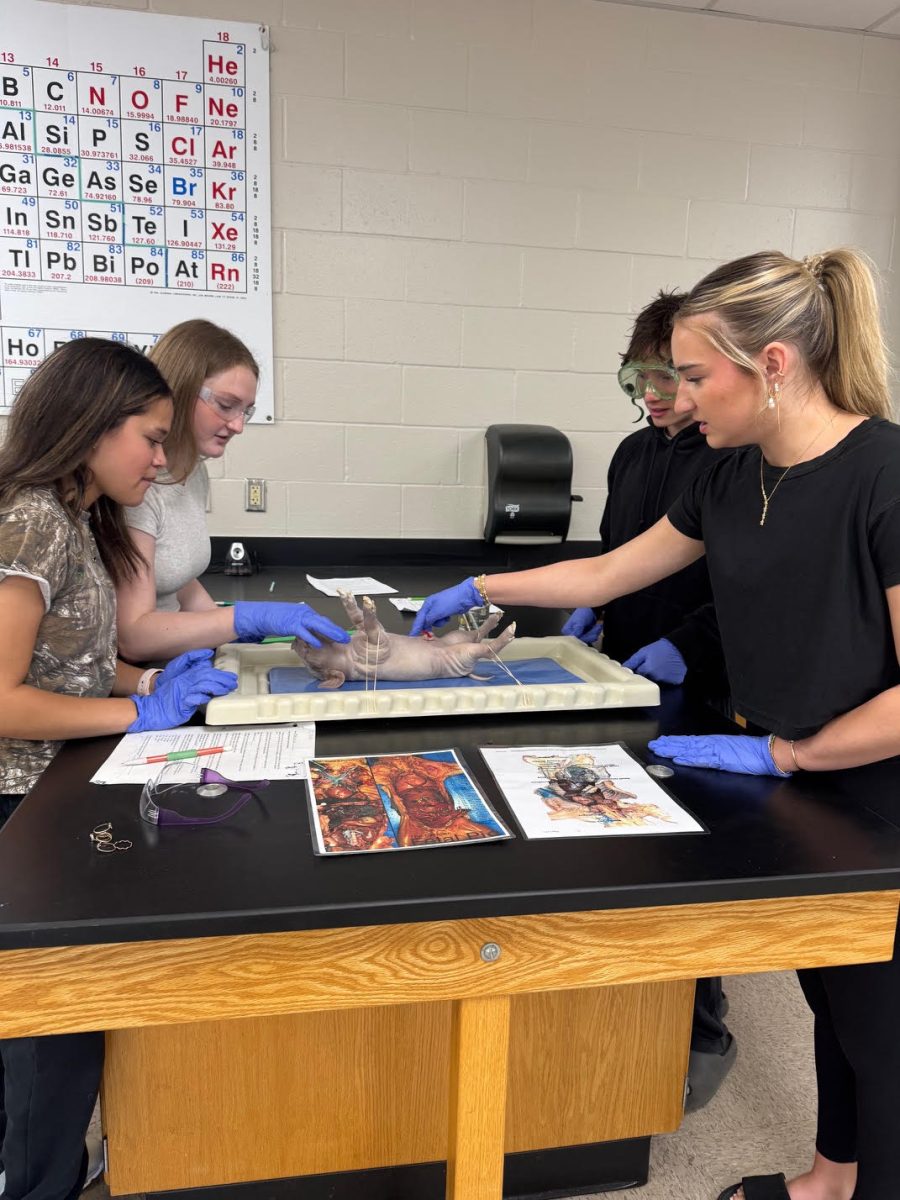
Imagine walking into science teacher Lisa Watson’s DC Biology class and getting sick from the stench.
That was Taylor harding-Black’s reality two weeks ago as she walked into class, having to leave after getting a whiff of the dissection fumes — formalin and pig organs.
All of the biology classes just finished dissecting animals, ranging from fetal pigs and sheep eyes to starfish. Despite the smell, classes love it, even if the smell, sights and even sounds are off-putting.
Mrs. Watson’s DC Biology class, learning about vertebrates and invertebrates, dissected both starfish and fetal pigs to compare them both. Even with the territorial differences, they both give interesting results during and after dissecting.
“Most of the kids love seeing the unique characteristics of the starfish after we’ve studied them,” Mrs. Watson said. “With the pigs, since they’re mammals, we can relate the organs to our organs, so it’s almost like seeing what’s inside them.
During dissection, students choose who has what job — moving the scalpel, handling the scissors, or being disgusted watching. ‘The surgeons,’ as Mrs. Watson calls them, are meticulous throughout, in most cases. There were also a few surprises during the dissections.
“I had one starfish completely butchered,” Mrs. Watson said. “We had one pig with an upside down abdomen and one with a tumor on its liver.”
Like Mrs. Watson, science teacher Christa Kimble saw reactions of excitement and disgust during the many dissections of sheep hearts, sheep eyes, and fetal pigs.
“Some students were triggered by the sight and they had to step into the hall away from it for a few minutes, but the majority of them did great.” Mrs. Kimble said. “One student passed out and hit the floor because she just stood with her knees locked and her brain shut her down for a few seconds.”
While none of the specimens are particularly difficult to dissect, according to Mrs. Kimble, the most difficult for students is the sheep eyeballs. Inside the sheep eyeballs are a number of structures, and the numerous systems in the eye are what make it harder.
“It’s packed, and if you cut in the wrong place, you destroy most of them,” Mrs. Kimble said. “Sheep also have a lining in the back of their eye called a tapetum lucidum that’s quite beautiful because it can be any shade of iridescent blue, gold or turquoise.”
Despite the pretty colors in a sheep’s eye, students’ favorite specimen to dissect is an entire fetal pig because of all they get to see. “They get to see an exact copy of what their own organs look like and how they are packed inside of their own body,” Mrs. Kimble said. “Internal pig anatomy is practically the same as a human’s anatomy.”
These dissections weren’t just for fun, even if it seems that way. Dissections are an extension of the human body systems unit in Biology. Since most of school is done manually with paper or on a computer, and then quizzed for a grade and forgotten, Mrs. Kimble wanted to have time to take on a unit that teaches with intent instead of just quickly summarizing.
“Those methods do not lend themself to learners that are more hands-on or tactile, and don’t apply to real life either,” Mrs. Kimble said. “Dissections offer a different style of learning about how nature builds these organisms. Students’ brains are more engaged and consequently, a deeper level of knowledge is gained by the experience.”
In any case, dissecting is unique in how it smells, how it works, and how it teaches students about the human body, even if the specimen isn’t the same. It’s a memorable experience that teaches all types of learners, if you can stomach it.