

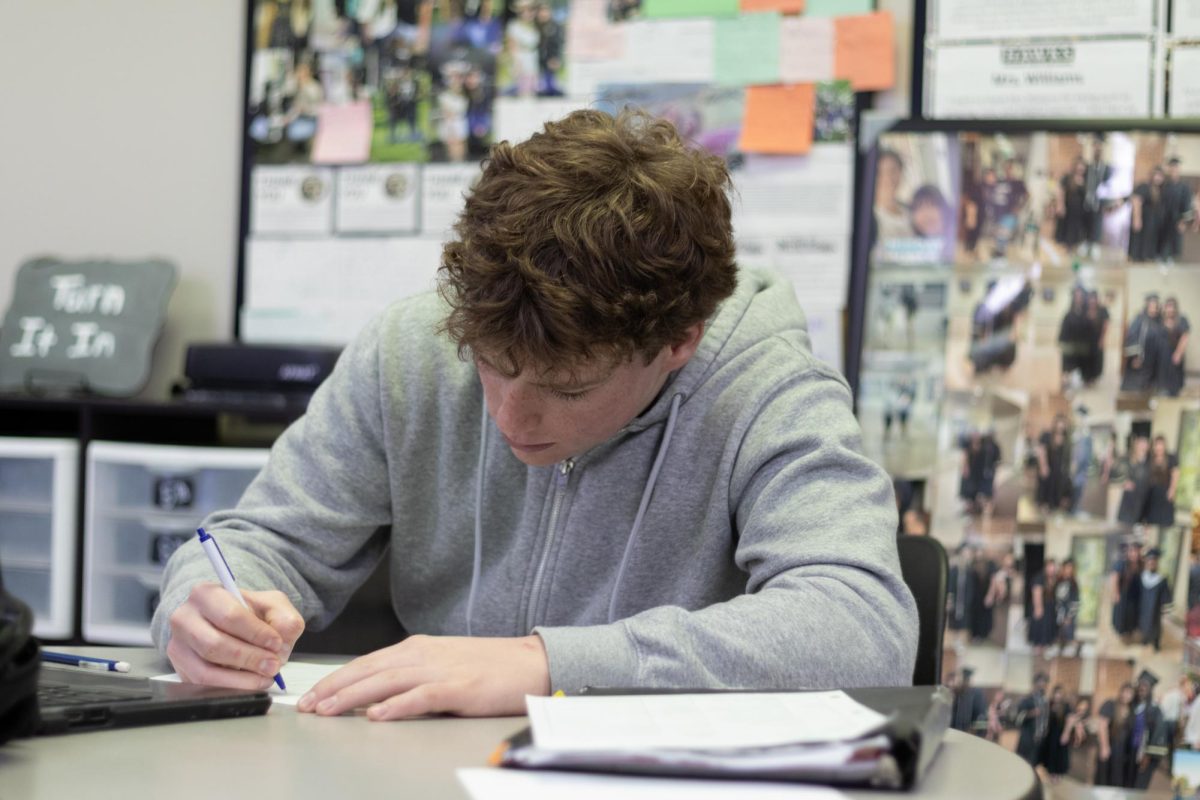
Reading hieroglyphics while grading essays – something English teachers Shelby Strebeck and Mitzi Quinn know all too well. Reading students’ handwriting seems more like deciphering ancient code to them, at least with some students.
Despite the struggles to read illegible handwriting, both Mrs. Strebeck and Mrs. Quinn are now requiring students to handwrite their essays and type them afterwards. The requirement was made in response to students’ AI usage to generate content for essays.
“I think the biggest reason we’ve done this is because we’re seeing an increase of people using AI to write a paper,” Mrs. Strebeck said. “AI is a great tool for a lot of educational purposes, but it’s not good for writing because it changes the student’s voice. They don’t know how to write or think critically when they continue to use AI.”
Mrs. Strebeck isn’t alone in her expectations for the new rule. Mrs. Quinn said she hopes the students will progress back into the old way of writing, or typing, essays.
“I think they will adjust, and I think it will make them use their minds more,” Mrs. Quinn said. “As that progresses, I can take them back to the computers, showing them the proper way to get information from AI without it being an AI generated paper.”
Students in these classes argue with the purpose and if the new rule really addresses the problem at all. Senior Tucker Keeney worries that this new rule unintentionally hinders students.
“Handwriting essays should, in theory, prevent the use of AI and other forms of plagiarism within our classes,” Tucker said. “But nothing is stopping a student from completely rewriting their essays on that final typing day.”
Tucker also believes that the problem the rule was intended to fix is never addressed, and the student will find more ways to escape working.
“The only thing that an AI-dependent person gains from this process is learning how to look productive while wasting your time,” Tucker said. “Lazy people are not going to want to do work no matter how much you change the system to ‘encourage’ productivity. This process only hurts everyone else and makes student morale plummet.”
Tucker isn’t the only one who finds the rule useless; senior Rylie Romero believes the rule is counterproductive and that if she has to hand write her essays, then the teachers should grade them on their own.
“It’s absolutely ridiculous that I have to handwrite an essay, just to type it up later on so my teacher can grade it with AI,” Rylie said. “If we have to hand write our essays, it’s only fair the teachers have to hand grade them.”
However, both Strebeck and Quinn note that they don’t use AI to grade. As checking for AI is necessary when typing an essay now, it also slows down the process of grading, and when it’s detected, it has to be run through a series of tests to check it thoroughly, which takes up more time.
“It’s slowed down our grading from having to do it on paper, but at the same time, it doesn’t slow it down as much as AI,” Mrs. Strebeck said. “Our desire is to have kids to become critical thinkers, to be able to think on their own, and be able to use information correctly, not just sell themselves short by using AI to generate something last minute.”
After seeing student feedback, Mrs. Quinn said she’s shocked at their assumptions about the grading process. She said that she does not use AI in the process of grading, but uses Eduphoria or Turnitin to check for plagiarism and AI usage, and if AI is detected, she runs the assignment through other AI detector sources to check if it is really plagiarized.
“It surprised me that my kids thought that AI grades their papers, because it doesn’t,” Mrs. Quinn said. “It just points out plagiarism, and it points out what could be AI writing, not necessarily that it is, but that it could be. So I’m trying to talk to them, to try to clarify that.”
In the meantime, both teachers will continue to decipher hieroglyphics to grade papers, but hopefully, student handwriting will improve as well as their critical thinking skills.